
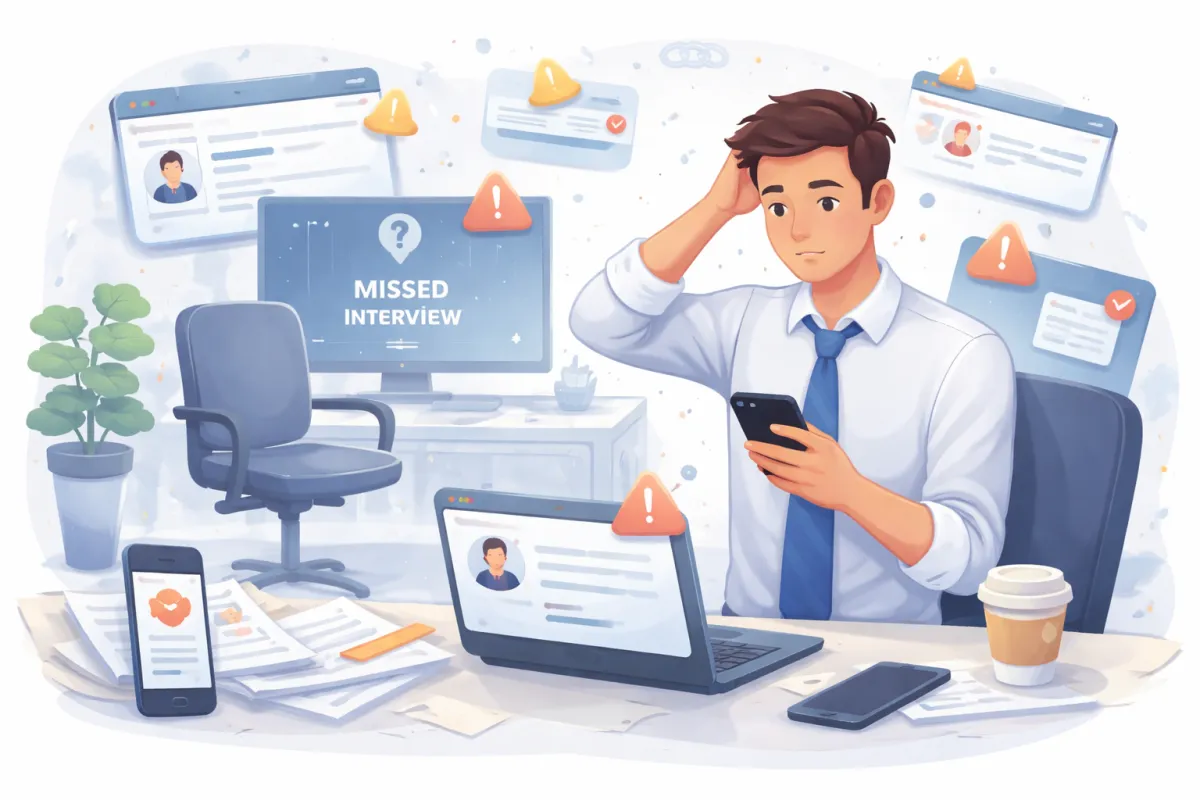
Why Do No-Shows Increase as Hiring Volume Grows?
At low hiring volumes, no-shows feel like bad luck.
At high hiring volumes, they feel inevitable.
Recruiters often explain rising no-show rates with surface-level reasons:
“Candidates today are unreliable”
“The market is too competitive”
“People apply everywhere”
But no-shows don’t increase randomly with volume.
They increase systematically.
The real issue isn’t that candidates change as companies scale —
it’s that process gaps expand silently, and candidates respond to those gaps with hesitation, disengagement, and absence.
This post examines why no-shows rise as hiring volume grows, and why the no-show itself is usually the last visible symptom of a much earlier breakdown.
The Core Misconception: Scale Only Changes Operations
Most teams believe scale affects:
Recruiter workload
Response times
Scheduling capacity
What they miss is this:
Scale also changes how candidates interpret silence, automation, and intent.
At low volume:
Interactions feel personal
Messages feel intentional
Silence feels temporary
At high volume:
Messages feel templated
Gaps feel impersonal
Silence feels dismissive
Candidate behavior adjusts accordingly.
1. Weak Reminders at Scale: Automation Without Reinforcement
As hiring scales, reminders are often treated as a “solved problem”:
One confirmation message
One calendar invite
One reminder before the interview
This works — until volume increases.
What Breaks at Scale
Reminder timing becomes generic
Messages lose context
Recruiters stop adding personal confirmations
Exceptions aren’t handled
Candidates don’t consciously analyze reminders.
They feel them.
A weak reminder doesn’t say:
“This interview matters.”
It says:
“This is just another automated event.”
And automated events are the easiest to forget.
2. Candidate Ambiguity Increases With Volume
As hiring volume grows, clarity often decreases.
Why?
Because teams optimize for throughput:
Shorter messages
Generic templates
Fewer clarifications
Less personalization
What Candidates Start Wondering
Who exactly am I meeting?
Is this screening or a real interview?
How long will this take?
Is this role still open?
How serious is this employer?
Ambiguity doesn’t cause immediate rejection —
it causes cognitive delay.
And cognitive delay is the seed of no-shows.
3. Time Gaps Stretch — and Intent Decays
At higher hiring volumes:
Scheduling slots fill faster
Interviews get pushed out
Time-to-interview increases
From an ops perspective, this seems reasonable.
From a candidate perspective, it’s dangerous.
Why Time Gaps Matter
Intent is volatile.
The longer the gap between:
Booking
andInterview
the more likely candidates are to:
Reprioritize
Accept other offers
Emotionally detach
Forget details
Assume they’re no longer a priority
No-shows don’t usually come from disinterest.
They come from faded intent.
4. Trust Erosion Through Silence
As systems scale, silence creeps in.
Not malicious silence — operational silence.
Examples:
No confirmation beyond automation
No reminders between booking and interview
No responses to clarifying questions
No human touchpoints
Candidates interpret silence contextually.
At low volume:
“They’re probably busy — but it feels legit.”
At high volume:
“This feels like a system, not a conversation.”
Trust erodes quietly.
And when trust drops, showing up feels optional.
5. Why No-Shows Lag Behind Process Issues
One of the most dangerous things about no-shows is timing.
They lag.
A process change breaks something today.
The no-show spike shows up weeks later.
Why?
Because:
Candidates don’t disengage instantly
Intent decays over time
System failures accumulate before surfacing
By the time leadership notices:
“Interview attendance is down”
The root causes are already embedded:
Poor reminder logic
Longer scheduling gaps
Increased ambiguity
Reduced trust signals
No-shows are not the problem.
They are the delayed outcome of unobserved process degradation.
The Scale Paradox: More Automation, Less Assurance
As volume grows, teams automate to survive.
But automation without reinforcement creates a paradox:
Messages increase
Assurance decreases
Candidates don’t want more messages.
They want confidence.
Confidence comes from:
Timely signals
Clear expectations
Human acknowledgment
Predictable follow-through
Automation that feels “hands-off” undermines all four.
Why Recruiters Often Misdiagnose the Cause
Recruiters experience no-shows at the end of the funnel:
Interview time arrives
Candidate doesn’t show
Calendar slot is wasted
So the blame feels personal:
Candidate behavior
Market conditions
Role competitiveness
But the causes live upstream:
Days earlier
In subtle gaps
Between systems
Between messages
By the time the no-show happens, recovery is impossible.
Reframing No-Shows as a Scale Signal
No-shows are not a discipline issue.
They’re a scale signal.
They indicate:
Intent is decaying faster than systems can support
Trust isn’t being reinforced between steps
Human assurance hasn’t scaled alongside automation
High-performing hiring teams don’t eliminate no-shows.
They stabilize them as volume grows.
That only happens when:
Intent is reinforced continuously
Silence is minimized
Gaps are treated as risk zones
No-shows are traced back to process, not people
Final Thought: No-Shows Are the Echo of Broken Momentum
Candidates don’t wake up and decide not to show.
They drift away — quietly, logically, predictably.
As hiring volume grows:
Weak signals matter more
Time gaps hurt more
Silence costs more
Trust decays faster
No-shows are simply where all of this becomes visible.
If your no-show rate is rising, don’t ask:
“Why are candidates flaky?”
Ask:
“Where did our process stop reinforcing intent?”
The answer is always earlier than you think.